Showing posts with label Toyota. Show all posts
Tuesday, April 17, 2012
Monday, January 17, 2011
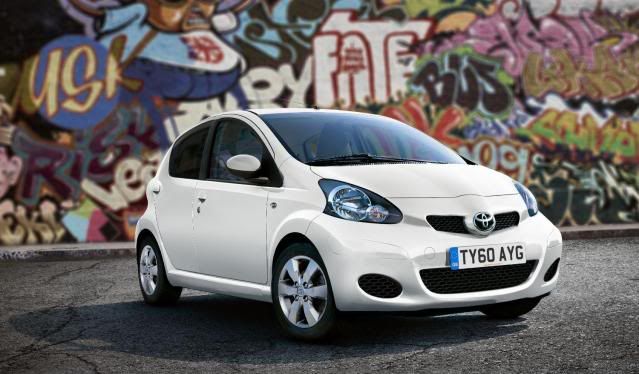
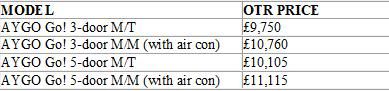
Toyota launches special-edition Aygo Go! (UK)
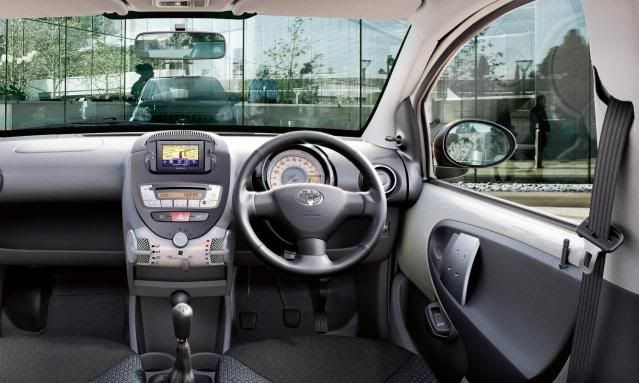
Toyota is launching a special edition of the popular Aygo city-car. Named Go!, it features a 4.3” touch-screen TomTom satellite navigation system w/voice recognition, Bluetooth, and a USB port.
The TomTom navigation system is equipped with useful points-of-interest (POI) including filling stations, hotels, service stations, cafes, and more.
The 4.3” touchscreen offers a bird’s eye view and can also display playlist and album details and SMS messages, with speech-to-text facility if required.
The Aygo Go! Also includes rear privacy glass, 14” alloy wheels, internally adjustable door mirrors, and a leather steering wheel to its standard specification.
New standard colours consist of Chilli Red and Cirrus White, with metallic Carbon Quartz available as an option. Also offered optionally are air-conditioning and an Aygo Style and Protection packs.
The Aygo Go! Also includes rear privacy glass, 14” alloy wheels, internally adjustable door mirrors, and a leather steering wheel to its standard specification.
New standard colours consist of Chilli Red and Cirrus White, with metallic Carbon Quartz available as an option. Also offered optionally are air-conditioning and an Aygo Style and Protection packs.
While Aygo Go! Arriving with both 3dr and 5dr, powering the car is a 1.0 VVT-i, 3-cylinder 68bhp petrol engine that’s mated to either a 5 speed manual or a MultiMode semi-automatic transmission.
Sales start now.
Labels:
Toyota
Thursday, January 13, 2011
Toyota Auris HSD or Hybrid Synergy Drive
Toyota Auris 2010 HSD, or Hybrid Synergy Drive, will officially go on sale in Europe later this spring. The car uses a 1.8-liter petrol engine and electric motor to provide nearly 62 mpg (US), consuming 3.8 liters of petrol per 100 km.Featured in the car is a four-cylinder 1.8-liter VVT-i petrol engine producing 98 PS (72 kW) and up to 142 Nm (105 lb-ft) of torque. The engine is coupled with a 60 kW electric motor kicking out up to 207 Nm (153 lb-ft) torque. Surprisingly, maximum combined output is kept at 136 PS (100 kW), which seems low considering the strength of the motor.
Still, the hybrid's direct emissions is reduced to about 89 grams of CO2 per kilometer. The car is kept more efficient by a 0.283 drag coefficient, down from 0.290 on the other Auris models. This is due to aerodynamic changes seen only on the HSD, including longer bumpers, and a better designed grille that improves air flow over the top and reduces resistance underneath. Different lamps can also be seen.
The setup lets the car run on all-electric for up to two kilometers, and at speeds up to 50 km/h (31 mph). Regenerative braking is also a part of the package. The car features four driving modes, like EV, Eco, and Power. The fourth was not mentioned.
The Auris HSD is available in three different trim levels, with the base level including 15-inch V-design alloys, stability control, push-button start, hill assist, and a rear spoiler. One level up adds 17-inch rims, six-speaker CD radio, and Bluetooth. The last step up adds on Alcantara trim. Several options are also on offer.
Labels:
Toyota
Wednesday, January 12, 2011
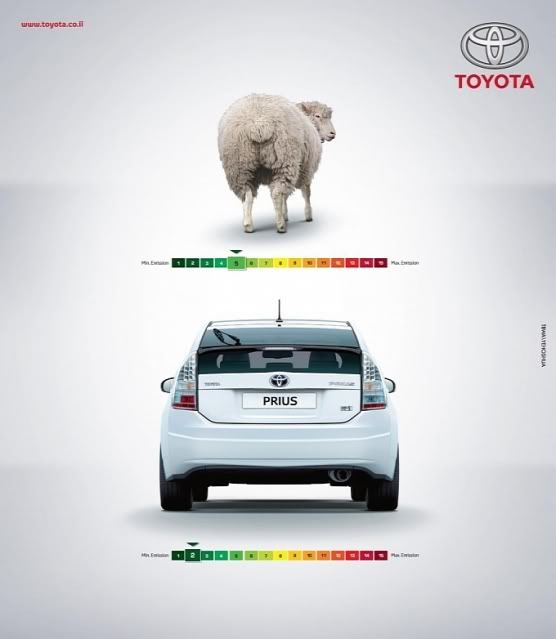
Toyota Prius less polluting than a sheep
Toyota’s Israeli division recently launched a television advertisement involving a sheep and a Prius hatchback. The point of the ad was to answer a question that has baffled many car enthusiasts; What’s more polluting, a Toyota Prius hybrid or a sheep?
According to Toyota, the sheep is more harmful. The methane gas produced by farm animals is indeed worse for the planet, however, Toyota has failed to mention the greenhouse gasses caused by manufacturing the car, and all that energy required to create the batteries.
Labels:
Toyota
Friday, December 24, 2010
Toyota Prius
There are two different schools of thought regarding the Toyota Prius hybrid. Some see it as the future of transportation a roomy family car that uses about half the fuel of a typical mid-size sedan. Other see it as the anti-car, a joyless, soulless form of transportation completely lacking in the character which car fanatics love so much. Personally, I can see both side of the argument and apparently so can Toyota, because they've attempted to imbue the all new Prius with something the old car lacked: Personality. Has it worked?


Labels:
Toyota
Toyota Matrix
If you are looking for an affordable vehicle with a lot of versatility, then the Toyota Matrix is the car for you. The Matrix was designed for people who want a vehicle with a sporty image and high functionality. It’s practical, stylish and affordable. It’s rated one of the best compact cars for hauling people and cargo in its price-class. The Matrix has a high safety rating; three stars for front-passenger protection and four stars for rear-passenger protection.Its large cargo area can be expanded by folding rear seats and folding the front-passenger seat. The Matrix also has: a durable plastic cargo floor, adjustable tie-downs for securing any bulky/messy cargo, a roomy backseat with five inches of head room (allowing it to accommodate adults), all-wheel drive, antilock brakes, and stability control. Under the hood, the Matrix has a 1.8L four-cylinder engine putting out 126-hp and 122 lb-ft torque. The Matrix will also get a combined 28 MPG according to Fueleconomy.
Labels:
Toyota
Tuesday, November 16, 2010
Mob Toyota Sports Cars Concept
The Mob is the proposal to Toyota Sports Cars Concept. Toyota MOB concept car, was designed by Spanish designer Jorge Marti Vidal. The Mobius strips have been involved into these cars. The Mob Toyota Sports Cars Concept is the work of Spanish designer Jorge Marti Vidal. The concept was developed during his final year of the Masters degree course in automotive design at the Universidad Politecnica de Valencia.
Mob Toyota Sports Cars Concept
The “Toyota MOB” is a cars concept that inspired by the idea of the Mobius strip incorporates unusual bodywork. There are the two films also available to change the interior and the exterior structure of this sports cars.
These two films are also responsible to form the dash board and the seats of the car. The main central area, where the driver is use to be seated, is transparent to feel real sensation of the car racing. With the help of the transparent central area, the driver of the Mob can view the ground closely. The wheels emulate the shapes of the blossoming flowers. The car was made of an organic material “liquid wood,” which is created using the waste product of lignin, left after the manufacture of paper.

The liquid wood is from one of the organic materials that can easily be modified into various shapes. The zero-emission car carries two continuous panels, which weave their way back and forth to form the body and the chassis. Moving on the wheels with built-in motors, the racing car includes an all-electric drivetrain to ensure an in-wheel drive. Measuring 3,643 x 1,787 x 1,063mm (LWH) in dimensions, the electric vehicle tout dynamic eco credentials without compromising the thrill.

To further improve the Toyota MOB’s eco-friendly credentials, the proposed drivetrain is all-electric – with each wheel getting its own dedicated motor. Vidal envisaged the Toyota MOB as a environmentally responsible racing car, but it could just as easily act as a lightweight sports cars. As such the car is fitted with a small cargo area for storing personal items.

Mob Toyota Sports Cars Concept
Adding more to Concept’s green factor is an all electric drivetrain, wherein all the wheels have individual motors to propel the car. Coming to its construction, the car is made of two panels that weave back and forth. The panels not only give this vehicle a perfect shape, but make up everything from the bodywork and chassis, to the seats and dashboard. The designer has envisioned an eco friendly and lightweight race car that makes environment feel happy.
Mob Toyota Sports Cars Concept
Labels:
Concept Car,
Sport Cars,
Toyota,
Toyota Concept Cars,
Toyota Sports Cars
Thursday, November 11, 2010
SEMA 2010: Toyota brings some swagger to Sin City
Seven million. That's how many times Toyota's much-loved Swagger Wagon rap video has been viewed on YouTube. Well, actually, it's 7,154,749... but who's counting? With that in mind, it's not surprising that the Japanese automaker has chosen to outfit its official SEMA floorspace with a customized Sienna dubbed, appropriately enough, Swagger Wagon Supreme.
Actor Brian Huskey, otherwise known as Swagger Dad, was on hand to introduce the stretched and lowered metallic blue Sienna minivan. He started his speech from inside the Wagon, which is decked out with a nicely finished wood floor along with plenty of cabinetry, televisions and computer paraphernalia.
Labels:
2010,
2010 SEMA Show,
cars,
news,
Toyota
Thursday, October 7, 2010
Paris 2010: 2011 Toyota Verso-S is a small MPV with big features
The mini-MPV segment is quite popular outside of the United States, and Toyota has just unveiled its newest member of that market – the 2011 Toyota Verso-S. We didn't know much about it earlier in the year, but the secrets have been spilled at the Paris Motor Show.
The Toyota Verso-S takes the stage as the shortest entrant into the B-MPV segment. However, the interior volume is on par with that of rivaling C-segment vehicles. It is the first car in this category to offer a multimedia, touchscreen system in the center stack. Down the line, an optional Navi-Box feature will be made available which boosts the multimedia capability but it also greatly enhances the navigation system features. The system can display speed camera warnings, sign posts on roadways and allows users to access numerous Google-based connected services. Points of Interest can be downloaded from the internet and entered as destinations. Also, the Navi-Box can display fuel prices, news and weather reports.
The 2011 Toyota Verso-S will go on sale in February 2011. Two engines will be made available; one diesel and one standard gasoline-burner. The diesel unit is a 1.4-liter diesel engine that produces 90 horsepower and 151 pound-feet of torque between 1,800 and 2,800 rpm. The 1.3-liter gasoline engine produces 99 hp and 93 lb-ft of torque. The gasoline engine is rated at nearly 43 miles per gallon while the diesel unit can hit 55 mpg. Both engines come standard with a six-speed manual transmission however the 1.3-liter can be paired with a seven-speed sequential unit and the 1.4-liter can be fitted with a six-speed automated manual.
Labels:
2010 Paris Motor Show,
2011,
cars,
news,
Toyota
Thursday, July 8, 2010
2010 Toyota Sports Car FT-86 G Sports Concept Car
Toyota baffled every car lover beyond belief when revealed the FT-86 G Sports Concept car on the very first day of the Tokyo Auto Salon 2010. The new concept car from the world's largest automaker has been revealed in person and virtually. The Toyota FT-86 G Sports Concept Car was introduced to the public at the Tokyo Auto Salon, and is proudly featured in the new trailer for Gran Turismo 5.
2010 FT-86 G Sports Toyota Concept Car
With an array of upgrades, particularly turbo charging of the Subaru-sourced 2.0-liter four-cylinder boxer engine, the example was developed to help promote Toyota’s new G Sports styling kits, exclusive to the Japanese market. Toyota plans to use the badge in series of cars modified by motorsports firm Gazoo Racing to be released only in Japan.Body modifications include a wider, and smoothed-out front bumper that leads to wider wheel arches. A new front spoiler can also be seen at the bottom. The car's hood, now with air vents, is made from carbon fiber.
The car has a new rear spoiler sitting on top of the decklid, which now includes a new strip of lighting. The rear bumper is more squared off, with a diffuser that brings the dual exhaust pipes to the center.
Toyota FT-86 G has rounded off exterior mods with a new set of 19-inch alloy wheels wrapped in high-performance Potenza RE050 tires size 245/40 R19 up front and 275/35 R19 at the rear. The only interior upgrade that is mentioned by Gazoo is the addition of a pair of Recaro bucket seats.
Labels:
2010,
Concept Car,
Sports Car,
Toyota
Wednesday, June 16, 2010
Toyota FT-86 to be called FR-S when it reaches production?
It's been awhile since we've heard anything on the tasty little Toyota FT-86 Concept, but it looks like we may finally have an idea of what the car will be called when it hits showrooms. If the rumors buzzing around the Toyobaru forums are to be believed, the Japanese manufacturer won't resurrect any of its fabled names from the company's past. Instead, it's possible that the sportscar may carry an FR-S badge. Toyota just filed a trademark application for the name, so there's a good chance that this particular internet whisper may have some meat to it.
We haven't completely decided where we stand on the FR-S name, partly because we had become so accustomed to calling the front-engine, rear-wheel drive heathen the FT-86. In the end, though, we don't really care what's on the car's badges so long as it makes it to production as an affordable, strong-performing coupe. Toyota could use something with a pulse in a big way, and a spiritual successor to the AE-86 Corolla would be just the ticket.
[Source: Toyobaru.net]
Labels:
2010,
Concept Cars,
news,
sports cars,
Toyota
Friday, May 21, 2010
Governator says Tesla teaming up with Toyota in Cali
California Governor Arnold Schwartzenegger has apparently let slip ahead of a scheduled 5pm Pacific announcement that Tesla Motors will be teaming up with Toyota to build electric cars.
While some might speculate that the agreement could result in the re-opening of Fremont's idle New United Motor Manufacturing Inc. plant (NUMMI), SFGate says that this is somewhat unlikely. Any production agreement will likely involve the forthcoming Model S sedan, and NUMMI's facilities are significantly larger than what the model will require, as it was originally scaled to accommodate the joint venture between Toyota and General Motors which required much greater capacity. The smart money is on a new factory location, probably in Downey, CA (in Los Angeles County).
It is not yet clear what Toyota will bring to the table or what, if any money or stock is changing hands with this rumored agreement. Also, no word yet on how Mercedes-Benz feels about all this – the German automaker already has a 10 percent stake in the company after opening its coffers to the struggling EV manufacturer back in May of 2009.
[Source: SFGate]
Friday, April 2, 2010
New York 2010: 2011 Scion iQ
Well, well, well – it looks like Toyota's iQ is coming to the U.S. after all, only it will be (as reported) sporting a Scion badge. Makes sense. Especially as according to Scion, the world's smallest four-seater is aimed squarely at a very young demographic. Not just young, but hip and urban, too. In fact, we were told that the iQ represents a "new urbanism," and is a vehicle for a "progressive buyer." We can hear Glenn Beck's aneurysm from here.
As for details, the "mini-er, smart-er" iQ sports a 1.3-liter engine delivering its not-yet-divulged power through a CVT. Mileage should be in the high 30s, which is reasonable but far from overwhelming for such a small package. The iQ will also ship with stability control, traction control and ABS, as well as ten – count 'em – ten airbags, as well as the industry's first-ever rear window bag. As for now, that's the whole story. We'll update you on price, performance specs, and on-sale date when we know more.
Scion Unveils a New Dimension at the New York Auto Show with All-New 2011 iQ and tC Production Models
NEW YORK (March 31, 2010) – A New Dimension of Scion was unveiled today with two new production vehicles – the all-new 2011 iQ premium micro-subcompact and the second-generation 2011 tC sports coupe – at the New York International Auto Show. The tC is scheduled to arrive in dealerships later this fall, while the iQ will go on sale in early 2011.
"Scion prides itself on being an innovative brand with a lineup of iconic vehicles that set automotive trends," said Jack Hollis, vice president of Scion. "The iQ will define the premium micro-subcompact segment as the choice for new urbanites who want clever transportation without a sacrifice in style or new features."
"The all-new tC features styling that is both refined and aggressive, appealing to a sports coupe owner who wants to make a bold statement. The tC has had the youngest median age buyer in the industry, and with more power, superior driving dynamics, and increased fuel efficiency, that should remain the case with the new tC as well."
iQ Defines Premium Micro-Subcompact
Meeting the needs of a new trendsetting generation of urban drivers, the iQ succeeds at taking big ideas and concentrating them into a small package. Made possible by intelligent and functional packaging, the iQ is a small car that offers the functionality and comfort that drivers expect from a car twice its size.
The iQ's profile, defined by a strong and high beltline, glides from the large, stout headlamps, up the A-pillar, across the roof and wraps around the rear, emphasizing the iQ's geometric shape. Side mirrors with integrated turn signals accent the clean design.
The rear emphasizes the vehicle's modern style. Trapezoidal lines run toward the wheels, from the hatch to the bumper's rear diffuser-like accent, creating a substantial presence. With a 78.7-inch wheelbase and a unique suspension design – consisting of MacPherson struts up front, and a torsion beam rear suspension – the three-door hatchback can deftly maneuver through city traffic. In addition, its overall length of only 120.1-inches, width of 66.1-inches, and short front and rear overhangs create a confident stance that still allows the iQ to fit into virtually any urban parking scenario.
Engineering innovations like a compact air-conditioning unit, inverted front-mounted differential, and electronic power-steering system with compact steering column, all amount to significant decreases in front-end length. In addition, the iQ is equipped with a flat gas tank housed beneath the floor that reduces rear overhang.
The iQ's functional "3+1" seating equates to the world's smallest four-passenger vehicle. With the driver's and front-passenger's seats being slightly off set, this innovative seating arrangement allows for one adult behind the front passenger and a child, small package, or pet behind the driver. A first for Scion, extra-slim front seat backs are utilized to provide rear passengers with ample legroom. The rear seats are extremely versatile, featuring a 50/50 split and the ability to fold flat, creating enough storage to accommodate up to two golf bags.
The iQ is small in size but large on safety. Active safety features include Vehicle Stability Control (VSC), an anti-lock brake system (ABS) with Electronic Brake force Distribution (EBD), Brake Assist (BA) and Traction Control (TRAC).
The iQ will come standard with 10 SRS airbags, including the world's first rear-window curtain airbag. Other airbags include driver- and front-passenger airbags; driver- and front-passenger seat-mounted side airbags; side curtain airbags; driver- and front-passenger knee airbags; and a Scion-first driver seat-cushion airbag.
The 2011 iQ is equipped with a 1.3-liter, four-cylinder engine that produces over 90 horsepower and features the latest dual VVT-i, which allows it to be impressively efficient, providing a broader powerband yet requiring less fuel and generating fewer emissions.
The iQ's engine is combined with a Continuously Variable Transmission (CVT) that helps deliver smooth acceleration and excellent fuel efficiency. The iQ will be rated as an Ultra Low Emission Vehicle (ULEV-II), and it is expected to achieve a combined fuel economy in the high 30s, comparable to similar vehicles that feature less passenger and cargo capacity.
The iQ comes standard with a six-speaker audio system and is available with multiple audio head units for various degrees of audiophiles. All iQs will be outfitted with USB and auxiliary ports, allowing personal devices to be easily integrated into the car. Steering-wheel-mounted controls command the audio system to adjust volume and shuffle through music sources such as CD, AM/FM, auxiliary input, or a library from your iPod® or other USB device.
All-New tC Sports Coupe Adds Power, Performance
Launched in 2004, the tC quickly became Scion's top-selling vehicle, at the same time attracting the youngest buyer in the entire industry. Six years later, the second-generation tC emerges with an aggressive new look, increased driving performance, and a more premium feel.
Enhanced performance is accomplished in the second-generation tC with an all-new 2.5-liter inline four-cylinder engine with dual VVT-i that generates 180 horsepower, 19 more than the previous model, and 11 additional lbs.-ft of torque. In addition to increases in power, the new engine delivers an increase in fuel economy all while lowering emissions. Performance is further improved and heard through a new intake manifold design and a sport-tuned exhaust system that delivers a bold and aggressive sound.
The tC features two all-new transmissions: the six-speed manual transmission has improved shift-feel and adds to the car's already fun-to-drive character, and a new six-speed automatic gains two gears along with sequential-shift.
The 2011 tC enters its second-generation riding on a new platform, including a specially tuned MacPherson strut front-suspension and a double-wishbone rear-suspension that rides lower than the previous model. Larger 18-inch aluminum-alloy wheels are wrapped in wider tires, giving the tC a broader stance and elevated handling characteristics. The new model also comes standard with larger 16-inch disc brakes on all corners. A new performance-tuned electronic power-steering system provides the driver a confident feel that is more in-tune with the road. The elements brought together in the new chassis result in a premium performance that expands the tC into a new dimension of driving enjoyment.
The all-new design of the 2011 tC projects a bolder and more aggressive stance. Important design cues like the helmet-inspired cabin shape were adopted from the Calty-designed Scion FUSE concept, which was unveiled at the 2006 New York Auto Show. The protruding fender flares amplify its wider, lower stance and are aggressively complemented by a sleek front grille and projector headlamps. The shape of the rear taillights flow cleanly into the overall shape of the trunk.
Inside, a driver-focused cockpit starts with a sporty new three-spoke steering wheel that features a flat bottom and a new shape that offers a confident grip. Front seats feature robust bolsters that provide secure positioning while still offering spaciousness and comfort. The instrument-panel, gauge cluster and center-console all face inward in a V-shape, making controls easily accessible.
Overall, the cabin has been lengthened for a more comfortable passenger experience with increased versatility. Utility is enhanced with reclining rear seats that split 60/40, providing more storage capacity. The panoramic moonroof remains standard in the new tC.
The new tC comes standard with an AM/FM/CD/USB audio system that features eight speakers. As with all Scion models, steering-wheel-mounted controls allow the driver to easily navigate through all of their music.
The new tC is also reinforced with key safety features and is expected to achieve top safety ratings. In addition to standard Anti-lock Brakes (ABS), the new tC also gains standard Vehicle Stability Control (VSC), traction control (TRAC), Electronic Brake Force Distribution (EBD) and Brake Assist (BA). Active front-headrests and eight airbags are also standard, including both driver and front-passenger knee airbags.
SCION iQ and tC
PRELIMINARY SPECIFICATIONS
2011 SCION iQ
POWERTRAIN
Engine: 1.3-liter, 4-cylinder with Dual VVT-i
Drivetrain: Front-wheel drive
Transmission: Continuously Variable Transmission (CVT)
DIMENSIONS (inches)
Overall Length: 120.1
Overall Width: 66.1
Overall Height: 59.1
Wheelbase: 78.7
Seating Capacity: 4
2011 SCION tC
POWERTRAIN
Engine: 2.5-liter, 4-cylinder with Dual VVT-i
Drivetrain: Front-wheel drive
Transmission: 6-speed M/T or 6-speed A/T with Sequential-Shift
DIMENSIONS (inches)
Overall Length: 174.0
Overall Width: 70.7
Overall Height: 55.7
Wheelbase: 106.3
Seating Capacity: 5
Labels:
2010,
2010 New York Auto Show,
cars,
news,
Toyota
New York 2010: Scion reveals better looking, more powerful 2011 tC
The big reveal for Scion at the 2010 New York Auto Show is staring you square in the face. Meet the 2011 tC. Scion describes the car as defining "refined aggression." They called it, "masculine," too. Even though the new car borrows fairly heavily from the 2006 Fuse concept (not to mention the outgoing tC), our collective jury is still out on the refined aggression part. But we'll go ahead and agree that the new model does indeed look more masculine, which is good for Scion, as the tC demographic not only skews young (most youthful in the industry it turns out), but very male as well.
As for what's new, the engine is now a 2.5-liter I-4, up from 2.4 liters. Power is up as well. The new tC ships with a respectable 180 horsepower and 173 pound-feet of torque. That's plus 19 ponies and 11 pound feet. The suspension is now "sport tuned" and the power steering is electronic, which Scion assured us better allows the engineers to dial in more steering feel. Uh-huh.
The new tC also gets better gas mileage than the previous car (no word yet on exactly how much better) and comes with two new transmissions. There's a six-speed automatic that features sequential-shift (Scion-speak for a manual shift mode) as well asa six-speed manual that promises more refined shifting than the old five-speed.
Other goodies include 18-inch wheels and larger tires, bigger brake rotors (Scion claimed 16-inch rotors front and back during the press conference, but that's... insane) and a flat-bottom steering wheel. The tC has been our favorite Scion ever since Scion replaced the fist-gen xB with the fatter second-gen model.
Scion Unveils a New Dimension at the New York Auto Show with All-New 2011 iQ and tC Production Models
NEW YORK (March 31, 2010) – A New Dimension of Scion was unveiled today with two new production vehicles – the all-new 2011 iQ premium micro-subcompact and the second-generation 2011 tC sports coupe – at the New York International Auto Show. The tC is scheduled to arrive in dealerships later this fall, while the iQ will go on sale in early 2011.
"Scion prides itself on being an innovative brand with a lineup of iconic vehicles that set automotive trends," said Jack Hollis, vice president of Scion. "The iQ will define the premium micro-subcompact segment as the choice for new urbanites who want clever transportation without a sacrifice in style or new features."
"The all-new tC features styling that is both refined and aggressive, appealing to a sports coupe owner who wants to make a bold statement. The tC has had the youngest median age buyer in the industry, and with more power, superior driving dynamics, and increased fuel efficiency, that should remain the case with the new tC as well."
iQ Defines Premium Micro-Subcompact
Meeting the needs of a new trendsetting generation of urban drivers, the iQ succeeds at taking big ideas and concentrating them into a small package. Made possible by intelligent and functional packaging, the iQ is a small car that offers the functionality and comfort that drivers expect from a car twice its size.
The iQ's profile, defined by a strong and high beltline, glides from the large, stout headlamps, up the A-pillar, across the roof and wraps around the rear, emphasizing the iQ's geometric shape. Side mirrors with integrated turn signals accent the clean design.
The rear emphasizes the vehicle's modern style. Trapezoidal lines run toward the wheels, from the hatch to the bumper's rear diffuser-like accent, creating a substantial presence. With a 78.7-inch wheelbase and a unique suspension design – consisting of MacPherson struts up front, and a torsion beam rear suspension – the three-door hatchback can deftly maneuver through city traffic. In addition, its overall length of only 120.1-inches, width of 66.1-inches, and short front and rear overhangs create a confident stance that still allows the iQ to fit into virtually any urban parking scenario.
Engineering innovations like a compact air-conditioning unit, inverted front-mounted differential, and electronic power-steering system with compact steering column, all amount to significant decreases in front-end length. In addition, the iQ is equipped with a flat gas tank housed beneath the floor that reduces rear overhang.
The iQ's functional "3+1" seating equates to the world's smallest four-passenger vehicle. With the driver's and front-passenger's seats being slightly off set, this innovative seating arrangement allows for one adult behind the front passenger and a child, small package, or pet behind the driver. A first for Scion, extra-slim front seat backs are utilized to provide rear passengers with ample legroom. The rear seats are extremely versatile, featuring a 50/50 split and the ability to fold flat, creating enough storage to accommodate up to two golf bags.
The iQ is small in size but large on safety. Active safety features include Vehicle Stability Control (VSC), an anti-lock brake system (ABS) with Electronic Brake force Distribution (EBD), Brake Assist (BA) and Traction Control (TRAC).
The iQ will come standard with 10 SRS airbags, including the world's first rear-window curtain airbag. Other airbags include driver- and front-passenger airbags; driver- and front-passenger seat-mounted side airbags; side curtain airbags; driver- and front-passenger knee airbags; and a Scion-first driver seat-cushion airbag.
The 2011 iQ is equipped with a 1.3-liter, four-cylinder engine that produces over 90 horsepower and features the latest dual VVT-i, which allows it to be impressively efficient, providing a broader powerband yet requiring less fuel and generating fewer emissions.
The iQ's engine is combined with a Continuously Variable Transmission (CVT) that helps deliver smooth acceleration and excellent fuel efficiency. The iQ will be rated as an Ultra Low Emission Vehicle (ULEV-II), and it is expected to achieve a combined fuel economy in the high 30s, comparable to similar vehicles that feature less passenger and cargo capacity.
The iQ comes standard with a six-speaker audio system and is available with multiple audio head units for various degrees of audiophiles. All iQs will be outfitted with USB and auxiliary ports, allowing personal devices to be easily integrated into the car. Steering-wheel-mounted controls command the audio system to adjust volume and shuffle through music sources such as CD, AM/FM, auxiliary input, or a library from your iPod® or other USB device.
All-New tC Sports Coupe Adds Power, Performance
Launched in 2004, the tC quickly became Scion's top-selling vehicle, at the same time attracting the youngest buyer in the entire industry. Six years later, the second-generation tC emerges with an aggressive new look, increased driving performance, and a more premium feel.
Enhanced performance is accomplished in the second-generation tC with an all-new 2.5-liter inline four-cylinder engine with dual VVT-i that generates 180 horsepower, 19 more than the previous model, and 11 additional lbs.-ft of torque. In addition to increases in power, the new engine delivers an increase in fuel economy all while lowering emissions. Performance is further improved and heard through a new intake manifold design and a sport-tuned exhaust system that delivers a bold and aggressive sound.
The tC features two all-new transmissions: the six-speed manual transmission has improved shift-feel and adds to the car's already fun-to-drive character, and a new six-speed automatic gains two gears along with sequential-shift.
The 2011 tC enters its second-generation riding on a new platform, including a specially tuned MacPherson strut front-suspension and a double-wishbone rear-suspension that rides lower than the previous model. Larger 18-inch aluminum-alloy wheels are wrapped in wider tires, giving the tC a broader stance and elevated handling characteristics. The new model also comes standard with larger 16-inch disc brakes on all corners. A new performance-tuned electronic power-steering system provides the driver a confident feel that is more in-tune with the road. The elements brought together in the new chassis result in a premium performance that expands the tC into a new dimension of driving enjoyment.
The all-new design of the 2011 tC projects a bolder and more aggressive stance. Important design cues like the helmet-inspired cabin shape were adopted from the Calty-designed Scion FUSE concept, which was unveiled at the 2006 New York Auto Show. The protruding fender flares amplify its wider, lower stance and are aggressively complemented by a sleek front grille and projector headlamps. The shape of the rear taillights flow cleanly into the overall shape of the trunk.
Inside, a driver-focused cockpit starts with a sporty new three-spoke steering wheel that features a flat bottom and a new shape that offers a confident grip. Front seats feature robust bolsters that provide secure positioning while still offering spaciousness and comfort. The instrument-panel, gauge cluster and center-console all face inward in a V-shape, making controls easily accessible.
Overall, the cabin has been lengthened for a more comfortable passenger experience with increased versatility. Utility is enhanced with reclining rear seats that split 60/40, providing more storage capacity. The panoramic moonroof remains standard in the new tC.
The new tC comes standard with an AM/FM/CD/USB audio system that features eight speakers. As with all Scion models, steering-wheel-mounted controls allow the driver to easily navigate through all of their music.
The new tC is also reinforced with key safety features and is expected to achieve top safety ratings. In addition to standard Anti-lock Brakes (ABS), the new tC also gains standard Vehicle Stability Control (VSC), traction control (TRAC), Electronic Brake Force Distribution (EBD) and Brake Assist (BA). Active front-headrests and eight airbags are also standard, including both driver and front-passenger knee airbags.
SCION iQ and tC
PRELIMINARY SPECIFICATIONS
2011 SCION iQ
POWERTRAIN
Engine: 1.3-liter, 4-cylinder with Dual VVT-i
Drivetrain: Front-wheel drive
Transmission: Continuously Variable Transmission (CVT)
DIMENSIONS (inches)
Overall Length: 120.1
Overall Width: 66.1
Overall Height: 59.1
Wheelbase: 78.7
Seating Capacity: 4
2011 SCION tC
POWERTRAIN
Engine: 2.5-liter, 4-cylinder with Dual VVT-i
Drivetrain: Front-wheel drive
Transmission: 6-speed M/T or 6-speed A/T with Sequential-Shift
DIMENSIONS (inches)
Overall Length: 174.0
Overall Width: 70.7
Overall Height: 55.7
Wheelbase: 106.3
Seating Capacity: 5
Labels:
2010,
2010 New York Auto Show,
2011,
cars,
sports cars,
Toyota
Wednesday, March 24, 2010
Toyota to replace pedals for owners not satisfied with fix
According to a Toyota memo first obtained by Jalopnik and later reported by the Associated Press, Toyota is currently notifying dealers that a replacement pedal can be installed at no charge to owners of recalled Toyota products if the owner is not satisfied with the current fix for the problem.
Most vehicles involved with the pedal recall have been fixed by inserting a metal shim into the accelerator pedal, which is believed to reduce friction and provide smoother travel to the pedal. The AP reports that owners who either do not feel confident in the fix or who still complain of pedal problems can ask their dealership for a new replacement pedal at no charge.
Through data analysis, it has been determined that at least 100 owners of recalled vehicles have filed complaints regarding pedal action after the dealership reportedly fixed the problem. Perhaps by witnessing this data, Toyota has responded to reduce further complaints by replacing the entire pedal assembly on vehicles with on-going problems.
The Associated Press quotes a portion of the memo as follows:
A replacement pedal should only be offered to a customer after the reinforcement bar has been installed and the customer has expressed dissatisfaction with the operation and/or feel of the pedal. (Pedal replacement) is based upon specific customer request only. Dealers are not to solicit pedal replacement.
The AP added that the memo lists vehicles involved as: the 2005-10 Avalon; 2007-10 Camry and Tundra; 2009-10 Corolla, Matrix and RAV4; 2008-10 Sequoia and 2010 Highlander. It remains uncertain if other vehicles such as the Prius may also be included in the replacement pedal process.
[Source: The Associated Press via Google, Jalopnik]
Tuesday, March 16, 2010
Toyota agrees with NHTSA investigation of runaway Prius, but not calling Sikes a liar
Toyota walked a fine line this afternoon when it revealed that its own two-day investigation of last week's runaway Prius near San Diego, CA had reached the same conclusion as the National Highway Traffic Safety Administration's investigation. That is, the brakes on Jim Sikes' 2008 Toyota Prius should have been able to stop the car. Toyota did not, however, go so far as to call Sikes a liar.
The investigation determined that the front brake pads were worn so far down from overheating that the rotors were scraping the pads' metal backings. According to investigators, this could have only happened if the brake pedal were applied lightly (less than 50% or so) for an extended period of time, not pressed firmly to the floor as Sikes claimed he was doing. Only by "dragging" the brakes lightly could they become so overheated and worn, as firmly pressing the brake pedal while the car is accelerating would engage the brake override system that cuts engine power.
Though asked repeatedly if they had concluded that Sykes was lying, representatives for Toyota insisted that was not their judgment to make and they could only say that the investigation's findings were not consistent with the scenario that Sikes describes.
Follow the jump for Toyota's official statement in which it details all eight points of its findings.
[Source: Toyota]
Tuesday, March 9, 2010
San Diego 'runaway Prius' has media buzzing
Both the second- and third-generation Prius are part of Toyota's massive recall – the former for floormat problems, the latter for braking issues – but a new incident from California has the automaker looking into more potential issues with the second-generation car.
As CNN tells it, Jim Sikes was driving his Prius on Interstate 8 in San Diego County when he pushed the gas pedal to pass a slow-moving car, but then, as Sikes says, "[the pedal] did something kind of funny ... it jumped and it just stuck there." Sikes called 911 for assistance, but a California Highway Patrol officer caught up to the car, and the officer used a loudspeaker to give Sikes instructions on how to safely stop the vehicle with the emergency brake. "As it was going, I was trying the brakes... it wasn't stopping," Sikes recounts. The highway patrol officer said that Sikes had reached speeds of over 90 miles per hour.
Neither Sikes or any other drivers were hurt during this alleged unintended acceleration incident. In a statement issued Monday night, Toyota says that it has dispatched a field technical specialist to investigate the case. Click through the jump to watch the CNN video and you can read more about it in Los Angeles Times link below. Thanks to everyone for the tips!
[Sources: CNN, Los Angeles Times]
Thursday, March 4, 2010
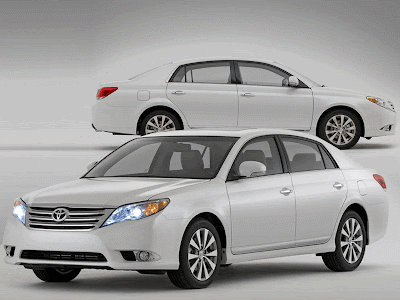
2011 Redesigned Toyota Avalon Third Generation

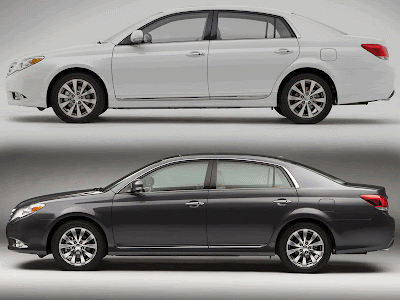
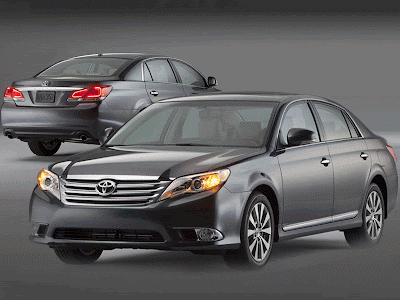
Evoking a time when travel was sophisticated, elegant and comfortable, the new Toyota Avalon possesses a distinctive new exterior style while offering a restyled interior rich with premium touch points and practical new technologies. Toyota introduced the boldly redesigned 2011 Toyota Avalon at the 2010 Chicago Auto Show. The third generation Toyota Avalon was introduced in four models: the standard XL, the sport Touring, the XLS, and the luxury Limited. Each combined generous interior room with powerful engine performance.

2011 Redesigned Toyota Avalon Third Generation
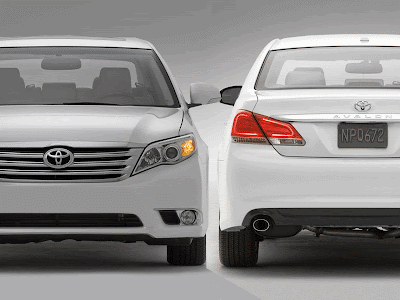
Designed at Toyota’s Calty Design Research in California, and assembled at Toyota’s Georgetown Kentucky manufacturing plant, the third-generation Avalons all have front grilles with horizontal chrome bars, large tail lamps, distinctive trunks, and dual exhaust outlets.
Even with numerous refinements inside and out, the Toyota Avalon remains true to the idea that comfort is honest and uncomplicated, and "Traveling Avalon Class" is rich in simple, familiar pleasures.

2011 Redesigned Toyota Avalon Third Generation
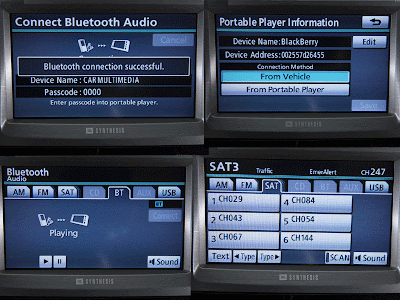
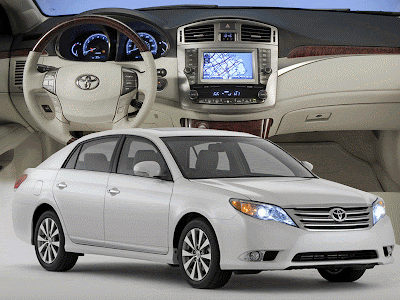
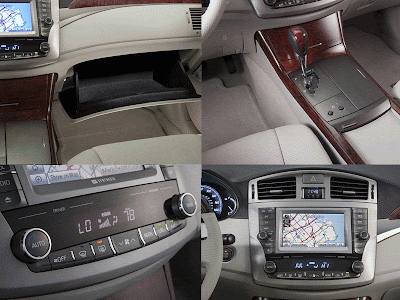
The new Toyota Avalon has dynamic and expressive lines, and an infusion of comfort, safety and technology advancements that enrich the driving experience. Upgraded equipment and technology features, such as a touch-screen navigation system with real-time traffic, and Bluetooth® hands-free phone capability with music streaming to the audio system are among the improvements that enhance the 2011 Avalon's excellent blend of spaciousness, comfort and technology.

2011 Redesigned Toyota Avalon Third Generation
"The Toyota Avalon has long been appreciated by smart, conscientious consumers who recognize quality materials and the beauty of detailed craftsmanship," said Bob Carter, group vice president and general manager, Toyota Division, Toyota Motor Sales, U.S.A. "The changes made for 2011 will allow us to build on our position in the premium large car segment. The competition does not stand still, and neither do we."

2011 Redesigned Toyota Avalon Third Generation
Restyled at Calty Design Research in Newport Beach, Calif., the Toyota Avalon is assembled at Toyota Motor Manufacturing Kentucky (TMMK), a "zero landfill" facility that also assembles the Camry, Camry Hybrid, and Venza. It was also developed at the Toyota Technical Center (TTC) in Ann Arbor, Mich. For 2011, Calty restyled Toyota Avalon to project an elegant, outgoing presence. A wider, more substantial grille ties into state-of-the-art projector headlamps, working with a broad, undisturbed front hood to suggest a lowered center of gravity and emphasize the Toyota Avalon's wide stance.

2011 Redesigned Toyota Avalon Third Generation
A power rear sunshade, deployable via a one-touch lever, filters direct sunlight coming through the rear window. The sunshade, which helps to protect rear seat passengers from unwanted light and heat, automatically detracts when the driver selects reverse gear. Toyota Avalon's exceptional combination of ample horsepower and excellent fuel economy offers one of the best overall dynamic performances in the large sedan segment.

2011 Redesigned Toyota Avalon Third Generation
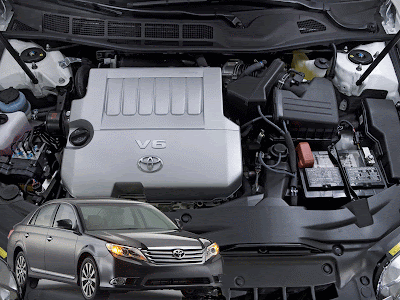
The 2011 Avalon is powered by a 24-valve, dual-overhead cam 3.5-liter V6 engine that produces 268 horsepower at 6,200 rpm. The engine is equipped with the latest dual VVT-i electronic valve-control mechanism that provides a broader powerband, while requiring less fuel and generating fewer emissions. It is mated to a multi-mode six-speed automatic transmission. The 2011 Toyota Avalon is an Ultra Low Emission Vehicle (ULEV), EPA-estimated to deliver 20 mpg in the city, 29 highway, and 23 combined, as good as or better than any V6 model in the segment.

2011 Redesigned Toyota Avalon Third Generation
The 2011 Toyota Avalon will be available in two grades when it arrives in showrooms in the spring of 2010, Avalon and Limited. Both grades will be well equipped with standard equipment like eight-way leather-trimmed power driver's seats, back-up camera, dual zone automatic climate control with air filtration, moonroof and 17-inch alloy wheels. Toyota Avalon will be available in nine exterior colors including three new colors: Zephyr Blue Metallic, Cypress Pearl and Sizzling Crimson Mica.
Labels:
2011,
Sports Car,
Sports Sedan,
Toyota
Wednesday, February 17, 2010
2011 Third-generation Toyota Sienna Minivan
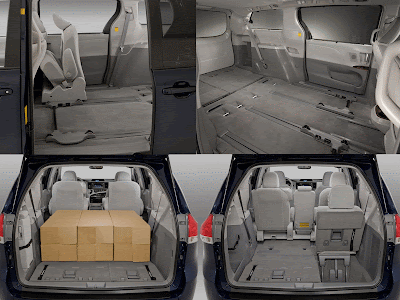
Toyota is the first carmaker in North America to be offering this innovation. The Auto Access Seat has a seat-mounted ingress/egress switch and a wireless remote control that allows for easy and flexible seat operation. The seat is able to rotate 90 degrees and can be lowered to within 19 inches of the ground to further facilitate easier passenger transfers at the exact height required. The Toyota Sienna is well known as a transportation solution for moving people and cargo comfortably and efficiently. The third-generation Toyota Sienna will look and drive more like a sedan, conform to new ideas about personal comfort, easily accommodate cargo, and handle big loads. The Toyota Sienna will come in five conveniently configured grades, all sharing a distinctly new visual direction and features. Toyota unveiled the all-new, third-generation Toyota Sienna minivan at a media conference at the 2009 Los Angeles Auto show.
2011 Third-generation Toyota Sienna Minivan
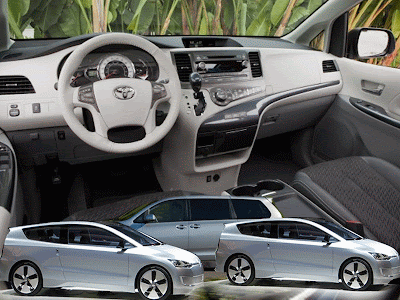
The 2011 Sienna has been reinvented to handle these needs as it shifts to a more expressive and dynamic vehicle with a stronger profile, high shoulder character and responsive handling. The 2011 Toyota Sienna may be the Japanese automaker's third-generation minivan, but Toyota emphasizes that the new Sienna is becoming more carlike than ever. The Sienna gets smart updates to its drivetrains and to its interior package for 2011-but not to its seating configurations, which still lag the class-leading Dodge Grand Caravan and Nissan Quest in flexibility. The Sienna is offered in a broad model range, and continues to be the only minivan with an all-wheel-drive option.
2011 Third-generation Toyota Sienna Minivan
The third-generation Sienna combines a contemporary style with features not previously seen in a minivan, and a fun-to-drive spirit that will surprise many, along with the flexibility, spaciousness and features that have defined the segment. The Sienna was designed by Toyota's Calty Design Research and developed at Toyota Technical Center in Ann Arbor, Mich., with assembly being accomplished at Toyota Motor Manufacturing, Indiana.
2011 Third-generation Toyota Sienna Minivan
A Toyota first rear-seat Dual View Entertainment Center is another innovative option. The system uses two displays side-by-side to create a seamless 16.4-inch widescreen image from a single source. When two separate entertainment options are called for, the system can split the screen into two individual screens, each with input from separate sources. Used as a single screen, it can be easily seen from the third row, and it can be operated from any seat via remote control. Used as two screens, the system can accommodate the preferences of two separate passengers who might want to play a video game or watch a second DVD simultaneously via auxiliary inputs.
2011 Third-generation Toyota Sienna Minivan
A choice of two responsive DOHC engines will be available: a 3.5-liter V6 or 2.7-liter four-cylinder engine. By adding the alternative of a four-cylinder engine, the 2011 Toyota Sienna is the first minivan in years to stray from the V-6-engine-only formula. Both engines offer the latest in efficient, lightweight technology, including Dual Variable Valve Timing with intelligence (VVT-i), roller rocker arms and an Acoustically Controlled Induction System (ACIS) that changes the length of the air-intake pipe to supply more torque on demand.
2011 Third-generation Toyota Sienna Minivan
The 3.5-liter V6 makes 266 horsepower at 6,200 rpm, with expected EPA-estimated mileage ratings of 18 mpg city/24 mpg highway (16 mpg city/22 mpg highway on AWD models). It also has a 3,500-pound tow capacity. With 187 horsepower at 5,800 rpm, the 2.7-liter four-cylinder engine produces responsive power that exceeds some competitors V6 performance, while delivering expected EPA-estimated fuel efficiency ratings of 19 mpg city and 26 mpg on the highway. Given its upgraded engineering, every Toyota Sienna will ride well and track cleanly through corners, but none more so than the newest addition to the line: the sporty SE.
2011 Third-generation Toyota Sienna Minivan
The Limited is designed for customers who want all the features with more luxury. The standard equipment list is extensive, including new second-row Lounge Seating and a power 60/40 Split & Stow third-row seat, front and rear parking sonar, dual moonroof, Smart Key, and Safety Connect™. Select options include those available on the XLE plus HID auto high-beam auto-high beam headlamps, rain-sensing wipers, and Pre-Collision System (PCS) with Dynamic Radar Cruise Control.
2011 Third-generation Toyota Sienna Minivan
The Toyota Sienna will come in five grades: Sienna grade, LE, SE, XLE and Limited. All-wheel-drive is available with the V6 on LE, XLE and Limited models. The all-new 2011 Toyota Sienna will begin arriving at Toyota dealerships in February 2010.
Subscribe to:
Comments (Atom)